Friday, June 10, 2022

Fun Images - Just Looking Around

This is just a fun collection of somewhat disjointed images. Some colorful and others showing different locations. Maybe something will bring a smile to your face.
This is a deceptive decoration in front of a home in our neighborhood. We have in our travels seen a myriad of stacked, somewhat flat and balanced rocks. We chatted with the owner about this arrangement and he told us there was a hole drilled down through the center of the rocks and a metal bar inserted there to hold the stack together. He also went on to explain that the round ball object on top was actually a bowling ball that he had glued the smaller rocks onto. Interesting albeit deceptive arrangement
We were walking through the neighborhood one morning and found this large turkey just walking the streets. It is a rather imposing bird. Later we chatted with a lady who had been trying to get into her car and the turkey kept chasing her around the vehicle. She finally got in and drove off. Glad he is up at the other end of the community. Turkeys can do an incredible amount of damage to your garden and flowers.
One day while driving on a back road up at higher elevation we saw this squirrel. This is a Douglas Squirrel sometimes called a Chickaree which is a collective name for the Pine Squirrel, Douglas Squirrel and American Red Squirrel. It sure has worked over the pine cone and did not seem the least bothered by our presence.


While walking through the neighborhood one morning we noticed this arrangement. Not sure if it was intentional or if the flowers and branches just happened. It seemed an interesting image to us.
The next three images were taken in Ukiah, Oregon. We were out for a drive just to look around one day and have lunch at “The Thicket”, a restaurant/bar there that we have been to before and like. In Ukiah there is a motel/hotel called Antlers Inn, a friend of ours, Patty Lynch, had stayed here one night when caught in a blizzard while out traveling. This is the front of the establishment and it is for sale in case anyone wants to get into the hotel business. Keep in mind that Ukiah is a small town and the winters can be harsh but if you want, go for it.
Unfortunately “The Thicket” was closed on the day we were there but a lady in the grocery store mentioned “Penny’s” in the park was open. Penny’s is this food trailer that serves a variety of hamburgers and sandwiches of various kinds. The food was quite good. “Penny’s” even had available Wi-Fi which surprised us. Great option for lunch.
While we sat eating our blue cheese burger a fellow pulled up on his John Deere to mow some of the grass area in the little park. The dog rode on the front of the mower staying in the same position the entire time he mowed in the park. It must have been a fun ride for the dog.
This is a peony flower. Very colorful and extremely intricate. There are a lot of peony here and we are always surprised how beautiful they are and how short their life span is. They seem to die off rather quickly but wonderful while they last.
We are told this is a Chinese Peony. It is quite a different looking plant than the regular peony.
Here is a closeup view of the Chinese Peony, certainly lovely to look at.
There are a lot of roses here. This is a really pretty lavender rose, very large blossoms.
Can you see the small spider? It is really well camouflaged. A bee was buzzing around the flower and the spider would move off and then come back to this position. Fascinating to watch.
Just in case you could not find the little spider it is here, circled in red. We said it was very well camouflaged.
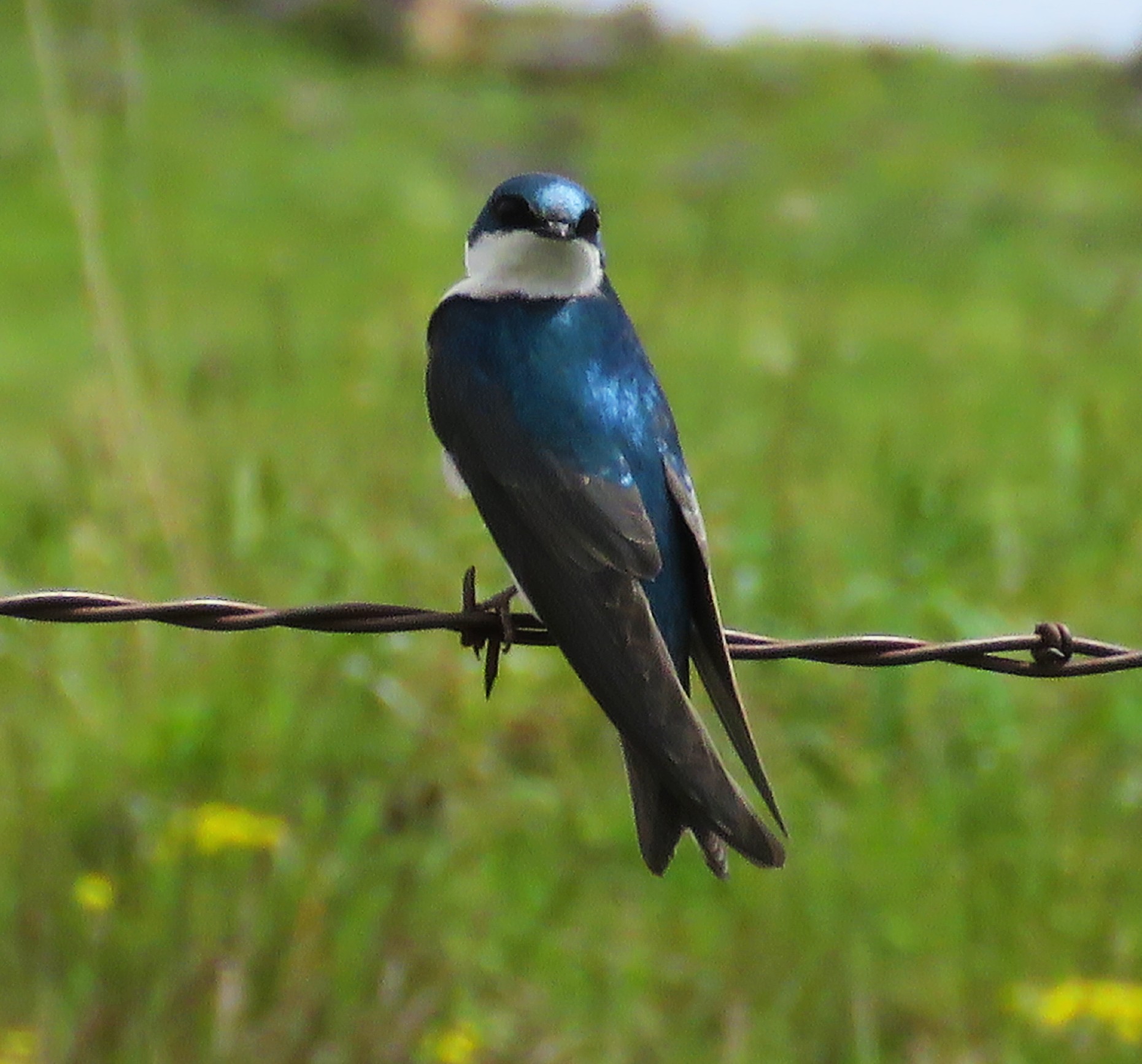
We will jump momentarily to fill in an item regarding the Bluebird Box adventure from a previous post. Here is a tree swallow that we had mentioned before. They use some of the Bluebird Nest Boxes that were intended for Bluebirds. That is fine, they need to live too and they eat a lot of bugs. We will just put up a few more boxes.
For reference here is a tree swallow in flight, very aerobatic.
This shows a nest box that has been utilized by tree swallows. Note the feathers used to partially line the inside. Bluebirds do not use feathers. It is fascinating to ponder, where do they get the feathers? Most interesting.


Shifting subjects a bit, actually quite a bit, here is an Iris we saw in the neighborhood. It is an almost black iriis. Quite striking in its unusual color.
Another Iris also somewhat unusual in color and very beautiful. No we do not walk around the neighborhood cuttng flowers for our table we just like to see and enjoy the color and the beauty.
Two American White Pelicans just resting on a pond in the bright sunlight. Their posture and the reflection just presented a peaceful image for us.

We hope you enjoyed this disjointed look around at various subjects and images.

Let us know if you have any questions or comments.

All the best - Stay safe - Be Well - George & Deanna

Monday, June 6, 2022

Little Goose Dam and the Paddleboat

There are four dams along the Snake River in Washington State. On Thursday June 2nd we took a drive to one of them, Little Goose Dam. There is a fair amount of controversy about removing the dams to enhance fish passage and restore the salmon runs along the Snake River. At this point in time the dams provide navigation passage for boats, transportation of commodities, and generation of hydroelectric power.

We will not get into whether they should be removed, rather just enjoy the trip for the day.
This image shows a map of the four dams along the Snake River. Ice Harbor - Lower Monumental - Little Goose - Lower Granite.

The Snake River originates in Wyoming and arcs across southern Idaho before turning north along the Idaho-Oregon border. The river then enters Washington and flows west to the Columbia River. The Snake River is about 1,078 miles in length.
This Google Map shows our driving route, the blue line, to Little Goose Dam, or destination. It is about 55 miles from our home here in Walla Walla out through beautiful rolling wheat country.
This overhead image of Little Goose dam shows the lock on the right hand side that allows large boats to pass the dam and shows the fish ladder that fish can use to circumvent the dam (it is the long pipe looking structure going across the image). It also shows the discharge of the water flowing out of the dam generating electricity.
As we were driving from Starbuck along the river towards the dam we saw this large sternwheeler or paddleboat going upriver toward the dam. The boat is named "American Pride". It seemed to us to be quite large, five separate decks high. We thought it would be interesting to see it go through the lock and continue it’s journey upriver to Clarkston, Washington,
Here is a look at the paddlewheel working on the boat. As we will see later, it appears that this is not the only propulsion system for the boat.
Here is just a closer look at the paddlewheel. Interesting and fascinating method of propulsion.
We can see the bridge being raised in preparation for the paddleboats passage. There is a road that crosses this lower portion of the dam providing vehicular access to various areas and this obviously needs to be raised to provide access to the lock for the boat.
Here the boat is approaching the lock. The bridge is raised and the lock is open. In the background, you can see the water flowing out of the damn generating power and the fish ladder is winding across parts of the facility.

The large paddlewheel on the back of the boat is not moving yet the poat is positioning itself to move into the lock, hence there must be other propulsion systems besides the paddlewheel.
The boat is entering the lock. The lock is about 86 feet wide, 100 feet high, and 668 feet long. The American Pride is 295 feet long and 46 feet wide and has capacity for 150 passengers. It does not have a problem fitting in the lock.
The boat is entering the lock.
The boat is fully in the lock and the bridge is being lowered. As big as the boat seemed to us going up the river it is dwarfed by the size of the lock.
As we can see in this image the lock has swallowed the boat and the massive doors are closing. The water will next fill the lock and raise the large boat to the upriver level.
Here we have relocated to the up river side of the dam and lock. There is another roadway bridge that provides access across the dam and it is being raised to allow boat traffic to pass out of the lock.

We were surprised to see another barge in the lock. Where the heck did that come from?
The barge is being pushed by a tug boat. The barge is used to transport small salmon called smolts around the dams. The smolts are trapped above Lover Granite, the first dam, upriver, and transported below Bonneville Dam on the Columbia River where they are released to continue their journey to the ocean..
The tug boat and fish carrying barge are heading up the river, clear of the lock.
Now we get a look at the paddleboat cruise ship, American Pride. It is coming out of the lock.

It took about 45 minutes from when the lock was closing to fill the lock and allow the boat to continue upstream.
Here is a closeup of the front of the boat. It seems that the dark object on the front is a gangplank device that provides for the passengers to get off at various ports of call.
It appeared to us that there were very few passengers on the paddlewheeler. The cost of the 8 day excursion from Astoria to Clarkston is from $4,600 to more than $6,700 depending on the accommodations you have. There are several stops along the way and excursions you can take from these stops.
The cruise ship is continuing its journey towards Lower Granite Dam about 37 miles up stream and then onto Clarkston. It will need to go through the lock at Lower Granite as it was seen doing here. at Little Goose.

We hope you enjoyed this look at Little Goose dam and the paddlewheeler called American Pride. It was fun to watch it traverse the lock and continue on it’s journey.

Let us know if you have any questions regarding this post.

Be Well - Stay Safe - All the best - George & Deanna

Tuesday, April 26, 2022

Placing Bluebird Nest Boxes

On Saturday April 23rd a good friend of mine, Tom Scribner, and I went out on a trip to the hills above Pomeroy, WA to put up a number of Bluebird nest boxes and to check the condition of existing boxes that we might find there.
This map gives you an idea of the area we visited and put up boxes. Mountain Bluebirds tend to like higher elevation open grassland country and above Pomeroy there is some amount of ideal habitat.
This is a Mountain Bluebird, the target species for the boxes we are going to deal with. There might also be Western Bluebirds in the area, we shall find out.
This shows the vehicle with the boxes and tools arranged. We took 22 boxes along with us and have some additional boxes prepared for a second trip in early May. Tom used to go regularly with his father and put up Bluebird boxes in many locations throughout the Blue Mountains in Washington.
Here we will take a moment and show the boxes we are going to put out. On the Internet, there is an enormous selection of Bluebird house plans and information. The houses we built and used are of a fairly common design but there are many variations as we shall see.

The front of the house has a 1 ½ inch round opening and in this design the side hinges open for cleaning.
Looking at the side we see there is a slot of ventilation allowing air to get in. It can get rather warm in the houses out in the open and direct sunlight. You can also clearly see the sloped roof to allow rain to run off. Normally the houses are left unpainted due to maintenance though we do have some painted ones that will be shown and explain in later slides.
Here we show the back of the birdhouse and you see the wires that will be used to tie the birdhouse to a fence post. As we will see there are various methods to attach the house and lots of different places to affix them. This is just the time tested solution that Tom has used for years and it seems to work just fine. One wire at the top of the birdhouse and one wire towards the bottom.
This will give you a feeling for the country and habitat we are going to be working in. It is higher elevation, probably 4,500 - 5,000 feet, wide open with lots of wheat fields and native grasslands.

The previous week we were scheduled to do this trip but it was snowing and nasty weather in Walla Walla so we luckily decided to postpone for a week. Good decision as the weather on the 23rd was fine.
Here is Tom with one of the boxes installed on a fence post. The posts are called T posts and they are used for the barbed wire fence lines. There is a lot of information on the Internet about which direction to face the house but the bottom line is put it up in good habitat and the Bluebirds will use it regardless of which direction it faces.
Tom is attaching one of the houses to a T post. He positions the house against the post and wraps the wires around the post securing the box to the post. Pretty simple technique, just try to pick a fairly straight up and down post so the box is not hanging too crooked.
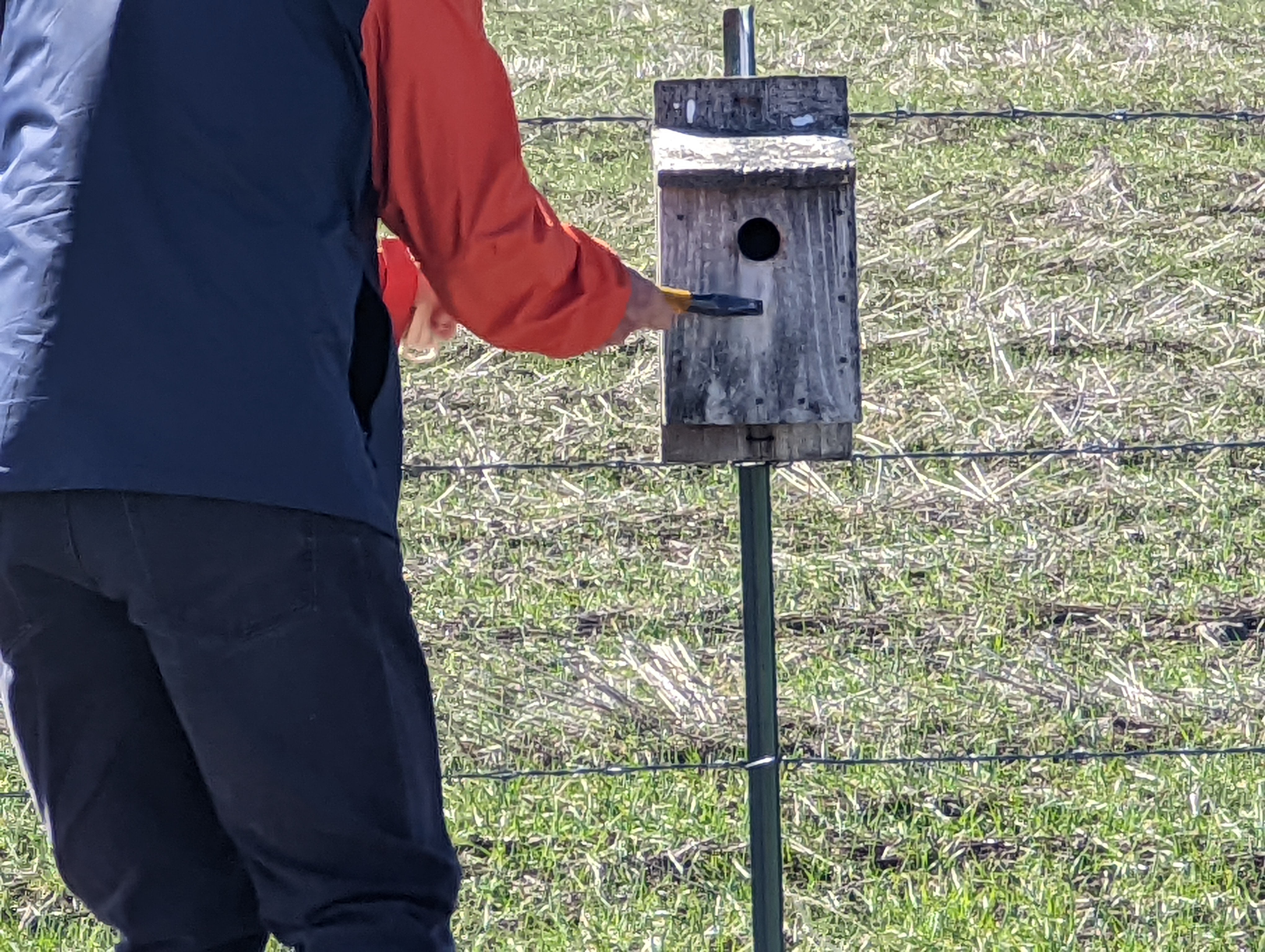
In addition to putting out new boxes we check the existing boxes and clean them out as appropriate. Tom is tapping on the box to ensure there is not a Bluebird sitting inside. We did not have much of that on this excursion as it was early in the season.

During previous trips Tom has tapped on the box with no apparent activity only to open the side and find a Bluebird sitting on several eggs not wanting to move.
Some of the boxes have not been checked in quite a few years and the nesting material just builds and builds. Here we see the grass being removed from one box, quite a bunch of nesting material.
This shows a bluebird box in need of repair. We are not the only people putting up boxes, which is great for the bluebirds. They have many nesting boxes available. This one appeared to have broken the top wire and the weather did some damage to the box. We brought about 12 back with us in varying states of disrepair. Some will be used for pieces and we will salvage what we can to make additional boxes.
This Bluebird box has succumbed to the weather. You can see in this image that it has come apart. The back remains on the fence while the rest of the box is lying on the ground. We shall see what if anything we can salvage.
Another view to show some of the scenery. This is looking north and it is a fairly clear day. The fence line along the right hand side of the picture is a great place to hang some houses. Tom tries to keep the birdhouses about 500 feet apart.
Here is a House Wren. A fairly common bird that can on occasion use the Bluebird nest boxes.
Often times when a male House Wren uses the nest box it is to show off its building prowess to the ladies. In this case it has filled the nest box with twigs. The bottom few inches are grasses or nesting material from previous nesting of bluebirds while the rest of the house is chock full of twigs. It certainly needs to be cleaned out for the spring season.
This was a different design of box that we saw along one of the roads. It does not appear to be designed for bluebirds as it is rather small.This also has a fancy little perch below the opening which is not needed for Bluebirds. Perhaps this box was meant for a house wren or another species.
As mentioned earlier, there are a number of people that put up bluebird houses out in the country. We have seens a wide variety of houses. In one fairly small area there were 7 blue bluebird houses like this one. A person built and painted them and put them up in various locations. Great for the Bluebirds.
Typically the houses Tom puts up are not painted. Here is a red one, one of eight that I built and we put up. The red paint came from the original boards. A person doing some work at our home had several boards in the back of his truck that he had acquired during demolition of a different project. I asked if I could have the boards and he said sure, they are just going to the dump. They were old beautiful boards with some holes and nails but certainly serviceable for bird houses. I wish he would have had several hundred of the boards but no such luck. Hence, we made some red houses.
Here is an example of an old box. Tom thought it may have been 12-15 years old. As you can see some folks attach them to a solid post. You will see them on telephone poles and all manner of vertical devices.
This image presents a couple of things. Bluebirds are not the only ones that use the houses. Tree Swallows will use them as well. At Lost Trail National Wildlife Refuge in Montana they will but two boxes up either back to back or really close together believing that one will be used by tree swallows and the other by bluebirds. Whatever works, it is all good nesting sites.

The other thing of note in this image is the different box. It is hinged so that the bottom opens for cleaning and is painted a light green. You can also note the swallow hanging on the opening. No perch is necessary for these cavity nesters.
Here is another view of the scenery. There was some amount of snow at the higher elevations but not much to bother us where we were.
Here is an image of a female mountain bluebird. This was taken at a different time and location. As you can see they will use various cavities for nesting. Here they are using an old woodpecker nest site in a burnt tree.
This image, also taken at a different location, is of a Western Bluebird. Note the orange or rust colored markings. During this excursion we saw 47 Mountain Bluebirds and did not see one Western. Often there is a mixture of the two species. Whether it was the elevation or the timing we could not discern as to why only one species.
In chatting with Tom, who has been coming to this location for a long time, he stated that several years ago we would not have seen nearly this many Bluebirds. All the various nest boxes have provided sites for the Bluebirds to raise their young. It is great to see the Bluebirds and wonderful to note they are doing so well.

We hope you enjoyed this look at the Bluebird boxes, the scenery, and the wonderful birds. We sure had a great time building and putting the boxes out.
Please let us know if you have any questions or comments.

All the best – Tom and George