On Saturday April 23rd a good friend of mine, Tom Scribner, and I went out on a trip to the hills above Pomeroy, WA to put up a number of Bluebird nest boxes and to check the condition of existing boxes that we might find there.
This map gives you an idea of the area we visited and put up boxes. Mountain Bluebirds tend to like higher elevation open grassland country and above Pomeroy there is some amount of ideal habitat.
This is a Mountain Bluebird, the target species for the boxes we are going to deal with. There might also be Western Bluebirds in the area, we shall find out.
This shows the vehicle with the boxes and tools arranged. We took 22 boxes along with us and have some additional boxes prepared for a second trip in early May. Tom used to go regularly with his father and put up Bluebird boxes in many locations throughout the Blue Mountains in Washington.
Here we will take a moment and show the boxes we are going to put out. On the Internet, there is an enormous selection of Bluebird house plans and information. The houses we built and used are of a fairly common design but there are many variations as we shall see.
The front of the house has a 1 ½ inch round opening and in this design the side hinges open for cleaning.
Looking at the side we see there is a slot of ventilation allowing air to get in. It can get rather warm in the houses out in the open and direct sunlight. You can also clearly see the sloped roof to allow rain to run off. Normally the houses are left unpainted due to maintenance though we do have some painted ones that will be shown and explain in later slides.
Here we show the back of the birdhouse and you see the wires that will be used to tie the birdhouse to a fence post. As we will see there are various methods to attach the house and lots of different places to affix them. This is just the time tested solution that Tom has used for years and it seems to work just fine. One wire at the top of the birdhouse and one wire towards the bottom.
This will give you a feeling for the country and habitat we are going to be working in. It is higher elevation, probably 4,500 - 5,000 feet, wide open with lots of wheat fields and native grasslands.
The previous week we were scheduled to do this trip but it was snowing and nasty weather in Walla Walla so we luckily decided to postpone for a week. Good decision as the weather on the 23rd was fine.
Here is Tom with one of the boxes installed on a fence post. The posts are called T posts and they are used for the barbed wire fence lines. There is a lot of information on the Internet about which direction to face the house but the bottom line is put it up in good habitat and the Bluebirds will use it regardless of which direction it faces.
Tom is attaching one of the houses to a T post. He positions the house against the post and wraps the wires around the post securing the box to the post. Pretty simple technique, just try to pick a fairly straight up and down post so the box is not hanging too crooked.
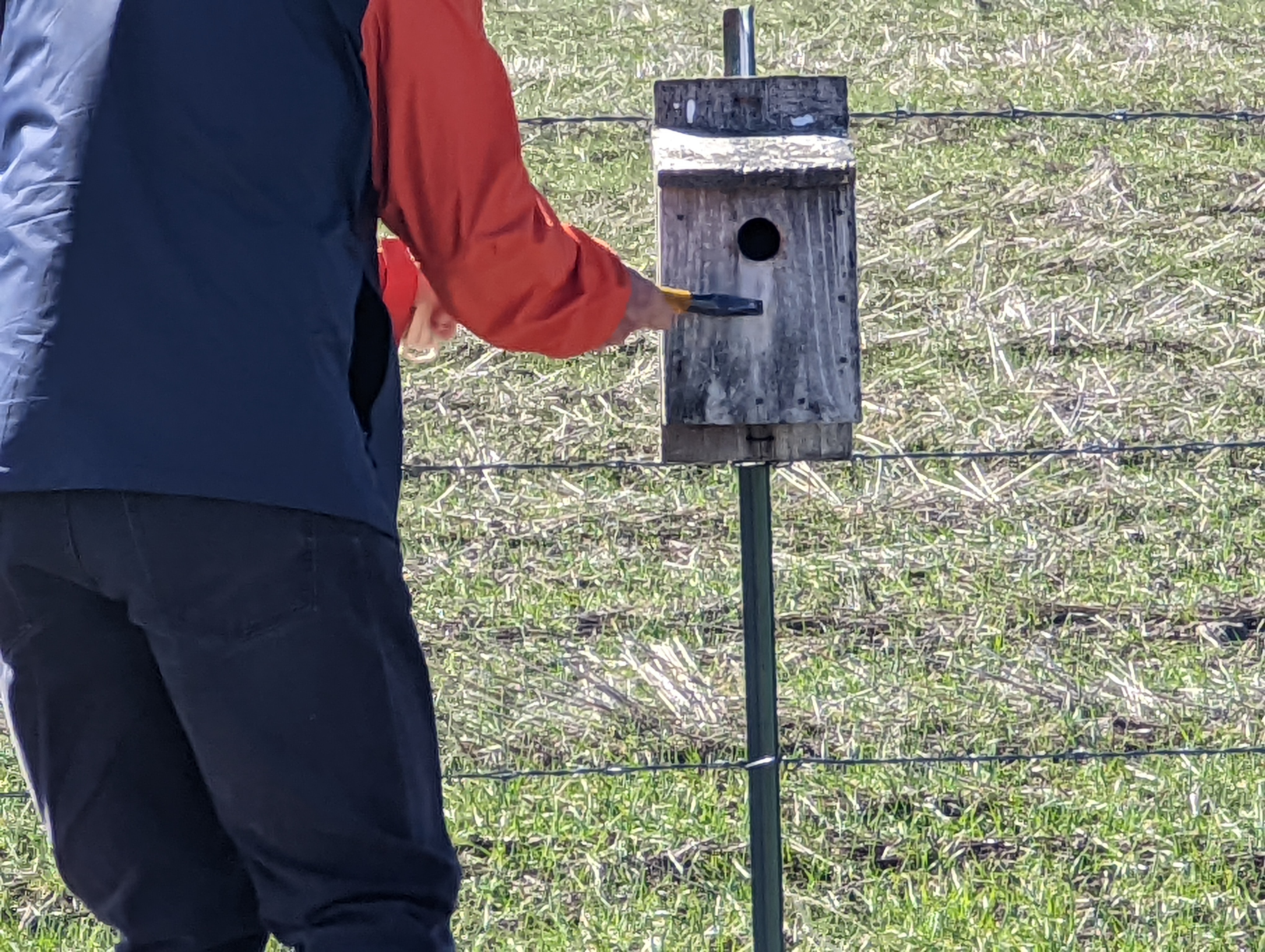
In addition to putting out new boxes we check the existing boxes and clean them out as appropriate. Tom is tapping on the box to ensure there is not a Bluebird sitting inside. We did not have much of that on this excursion as it was early in the season.
During previous trips Tom has tapped on the box with no apparent activity only to open the side and find a Bluebird sitting on several eggs not wanting to move.
Some of the boxes have not been checked in quite a few years and the nesting material just builds and builds. Here we see the grass being removed from one box, quite a bunch of nesting material.
This shows a bluebird box in need of repair. We are not the only people putting up boxes, which is great for the bluebirds. They have many nesting boxes available. This one appeared to have broken the top wire and the weather did some damage to the box. We brought about 12 back with us in varying states of disrepair. Some will be used for pieces and we will salvage what we can to make additional boxes.
This Bluebird box has succumbed to the weather. You can see in this image that it has come apart. The back remains on the fence while the rest of the box is lying on the ground. We shall see what if anything we can salvage.
Another view to show some of the scenery. This is looking north and it is a fairly clear day. The fence line along the right hand side of the picture is a great place to hang some houses. Tom tries to keep the birdhouses about 500 feet apart.
Here is a House Wren. A fairly common bird that can on occasion use the Bluebird nest boxes.
Often times when a male House Wren uses the nest box it is to show off its building prowess to the ladies. In this case it has filled the nest box with twigs. The bottom few inches are grasses or nesting material from previous nesting of bluebirds while the rest of the house is chock full of twigs. It certainly needs to be cleaned out for the spring season.
This was a different design of box that we saw along one of the roads. It does not appear to be designed for bluebirds as it is rather small.This also has a fancy little perch below the opening which is not needed for Bluebirds. Perhaps this box was meant for a house wren or another species.
As mentioned earlier, there are a number of people that put up bluebird houses out in the country. We have seens a wide variety of houses. In one fairly small area there were 7 blue bluebird houses like this one. A person built and painted them and put them up in various locations. Great for the Bluebirds.
Typically the houses Tom puts up are not painted. Here is a red one, one of eight that I built and we put up. The red paint came from the original boards. A person doing some work at our home had several boards in the back of his truck that he had acquired during demolition of a different project. I asked if I could have the boards and he said sure, they are just going to the dump. They were old beautiful boards with some holes and nails but certainly serviceable for bird houses. I wish he would have had several hundred of the boards but no such luck. Hence, we made some red houses.
Here is an example of an old box. Tom thought it may have been 12-15 years old. As you can see some folks attach them to a solid post. You will see them on telephone poles and all manner of vertical devices.
This image presents a couple of things. Bluebirds are not the only ones that use the houses. Tree Swallows will use them as well. At Lost Trail National Wildlife Refuge in Montana they will but two boxes up either back to back or really close together believing that one will be used by tree swallows and the other by bluebirds. Whatever works, it is all good nesting sites.
The other thing of note in this image is the different box. It is hinged so that the bottom opens for cleaning and is painted a light green. You can also note the swallow hanging on the opening. No perch is necessary for these cavity nesters.
Here is another view of the scenery. There was some amount of snow at the higher elevations but not much to bother us where we were.
Here is an image of a female mountain bluebird. This was taken at a different time and location. As you can see they will use various cavities for nesting. Here they are using an old woodpecker nest site in a burnt tree.
This image, also taken at a different location, is of a Western Bluebird. Note the orange or rust colored markings. During this excursion we saw 47 Mountain Bluebirds and did not see one Western. Often there is a mixture of the two species. Whether it was the elevation or the timing we could not discern as to why only one species.
In chatting with Tom, who has been coming to this location for a long time, he stated that several years ago we would not have seen nearly this many Bluebirds. All the various nest boxes have provided sites for the Bluebirds to raise their young. It is great to see the Bluebirds and wonderful to note they are doing so well.
We hope you enjoyed this look at the Bluebird boxes, the scenery, and the wonderful birds. We sure had a great time building and putting the boxes out.
Please let us know if you have any questions or comments.
All the best – Tom and George
Tuesday, April 26, 2022
Thursday, August 26, 2021
Sugar Bats
There are two species of bats in this area that are called sugar bats and they are found in August in abundance here in South Eastern Arizona. The two species are the Lesser long-nosed bat and the Mexican long-tongued bat.
They will drain the hummingbird feeders at night, if left up, and are very sloppy eaters. They do pollinate cacti and agaves so their sugar splurge at the hummingbird feeder is just a side light for quick energy and a nice snack.
Out on the front patio, the bats are regular visitors to the hummingbird feeders so we decided to get some pictures. The Lesser long-nosed bat, which is species we have in these pictures, is a relatively large bat compared with most U.S. bat species. It measures about 2.75 to 3.75 inches in total length, with about a 14 inch wingspan and can be dark gray to "sooty" brown in color and has a prominent nose leaf at the tip. Its long tongue, which we will see in later images, an adaptation for feeding on flower nectar, can be extended up to three inches. This image gives you a better perspective on the wingspan. The red hummingbird feeder is 8 inches across. You can see the small foot resting on the feeder but they don’t really rest and eat rather lurp and slurp on the fly. You can often see multiple bats at the feeder at one time. Again, one has a foot on the rail probably for balance while eating. This bat has just left the feeder and is heading off into the night. You can see part of its tongue in the picture It is still licking its chops from the savory sugar water. The feeder contains the basic hummingbird recipe 4 to 1, putting a cup of water in a measuring cup and adding ¼ cup of sugar.
This is how they feed but very quickly. They are almost totally silent in their flight even as they pass close by you. The patio is fairly small and when they are in large numbers they can get rather close. We have not seen them hit each other, the walls, nor us. Fortunately, the bats are very accurate and efficient fliers. Here are two more at the feeder. The one on the left is showing his long tongue. It is a Lesser long-nosed bat so the tongue on the Mexican long-tongued bat must really be quite long.
We hope you enjoyed the brief look at the sugar bats. If you do spend any time down here in Southern Arizona, in August, be sure and take the feeders down at night, they will certainly empty them if you do not.
Please let us know if you have any questions or comments.
All the best – George & Deanna
Wednesday, August 4, 2021
Mostly Hummingbirds
This is a blog post mostly about hummingbirds. We have been trying to find some hummingbirds recently as August is a prime time for hummers in South East Arizona. There are supposedly 13 or 14 different species that you can see at various places near here. This post will only show a few species and we will post again later in August if we can find more. There are some fun pictures here.
Broad-billed Hummingbird – Showing the male’s red and black bill, the emerald colored body, and the bright sapphire colored throat. They can be found in South Eastern Arizona in the summer.
This image is of another Broad-billed at a feeder. Not sure what is the situation with the wing feathers, he seems to be missing a few as we will see in some subsequent images.
Here is a Juvenile Male Broad-billed Hummingbird. You can see the coloration on the throat developing. Note all the wing feathers and their arrangement compared to the previous image.
Black-chinned Female Hummingbird. The bill is solid back, there is no orange coloration. The white tips on the tail feathers and the light subtle markings on the throat indicate a female Black-chinned. There is a small white comma shape behind the eye not the longer white streak as seen on the Broad-billed.
We would imagine that many of you have hummingbird feeders and see them chasing each other around. In many cases they are trying to protect the food source from other individuals. Some species can be much more aggressive than others; here we see a female Black-chinned and an immature Broad-billed having a discussion around the feeder.
Violet-crowned Hummingbird – This is another summer visitor to South Eastern Arizona. They have an unmistakable long white neck, throat and underside. Also note the orange bill with the back tip. The violet crown for which they are named does not show up in this image because of the shadows and location of the feeder back in the trees.
Hummingbird – What – Wait – For those of you not ornithologically inclined this is actually not a hummingbird, it is a female Gila Woodpecker. They are often seen at feeders and can drink from them with their long tongue.
Here is a young Black-chinned Hummingbird. The subtle patterning on the chest, the bill size and structure, and the overall coloration indicate a Black-chinned Juvenile.
Here is just an interesting image of a male juvenile Broad-billed. Sure seems to have long wings.
This is a female Broad-billed Hummingbird. Note the orange coloration on the bill. There are no markings on the neck or chest. She might be looking up to see if someone is going to attack.
This is a little different view of a Female Black-chinned Hummingbird. Note the subtle markings on the throat. The end of the beak gets lost in the blackness of the background.
Here we see more quarreling at the feeder. They are two juvenile Broad-billed Hummingbirds going at each other. It was really dark back in the trees where they were having their discussion.
This image concludes the brief discussion on Hummingbirds. A Male Broad-billed is leaving the area.
We hope you enjoyed this brief look at some Hummingbirds. We will keep looking for more of them to photograph and share with you. They are a lot of fun to watch.
Please let us know if you have any questions or comments.
All the best – George & Deanna
We hope you enjoyed this brief look at some Hummingbirds. We will keep looking for more of them to photograph and share with you. They are a lot of fun to watch.
Please let us know if you have any questions or comments.
All the best – George & Deanna
Sunday, August 1, 2021
Flowers - A Lizard - Shorebirds - A Neat House
In this blog post we will look at a couple of flowers, some shorebirds since the southward migration is underway, a lizard, and an old house out by itself. Come along and look at what we found.
It has rained quite a bit here recently and I noticed the morning droplets on this rose in our back garden. It turned out to be a decent image, nice looking red rose.
This lizard has some interesting markings. It is about 8 inches long and was on the wall by the front door one morning. It has absolutely no problem running up and down the wall on the house. I am sure the texture from the stucco helps with the traction.
Now if the lizard can only bring with him a few friends and eat more of the flies that are somewhat annoying, that would be wonderful. We were over near Willcox AZ, a location we have mentioned before that has some water settlement ponds. The shorebird migration is underway and many of the shorebirds will stop here to rest up and then continue south to escape the cold of the winter. You can see a wide variety of shorebirds at this time of year passing through.
Here are two Back-necked Stilts and the bird in the center is a Willet. The Black-necked Stilts actually have two legs they just rest on one and tuck the other up in their feathers. Here is a group of Black-necked Stilts as you can see they do have two legs, well most of them. This is a group of American Avocet. They are a long legged shorebird with a bill that curves upwards on the end. They will often time keep their bill open a little and sweep it side to side it just below the surface of the water to feed on tiny food items.
Note the Willet in the middle of the Avocets. It is a different Willet than shown earlier as the markings are much darker showing he is still in partial breeding plumage. The flock of Avocets has been joined by a group of Wilson’s Phalaropes who are passing through on their way south. The Phalaropes will spend the winter in South America.
The female Phalarope will lay the eggs in the spring and then leave the nest having the male incubate, feed, and raise the young. The female is brighter colored than many other females of bird species because she does not need to sit on the nest hiding her presence with drab coloration, that’s the male’s job here. A thunderstorm with some rain had just passed through when this Song Sparrow appeared. It certainly needs to work on feather management but it is fine with skipping the afternoon shower. This is the flower of what we believe to be a White Torch Cactus. It blooms only for a few days here and then the flower dies off. It is beautiful flower to have such a short lifespan. This is a Snowy Egret, a wading bird that stands a little over two feet tall... It is identified from other egrets (Cattle Egret and Great Egret) by having yellow feet. Often times they are called Golden Slippers. No it did not raise its foot on command, we just happened to catch one foot in the air while it was walking. This is a Gamble’s Quail chick and it is about half grown. While quietly sitting on a bench watching for birds an adult pair of Gamble’s came walking down the trail in front of the bench and there were four chicks with them all the same size as this one. It is much easier to identify the young ones when Mom and Dad bring them along. Here is a decent house. Just a few shingles, some paint maybe a window or two and some good looking doors and you are ready to move in. Somewhere in the process you would want to fumigate, a lot, before your personal belongs were moved in. Nice house in dark sky country the night stars would be absolutely amazing. There is not much near here for miles.
That concludes our look around at various flowers, lizards, and birds. We hope you enjoyed the sojourn and found something of interest.
Please let us know if you have any questions or comments. All the best – George & Deanna
All the best – George & Deanna
Subscribe to:
Posts (Atom)