In this blog post we will look at a couple of flowers, some shorebirds since the southward migration is underway, a lizard, and an old house out by itself. Come along and look at what we found.
It has rained quite a bit here recently and I noticed the morning droplets on this rose in our back garden. It turned out to be a decent image, nice looking red rose.
This lizard has some interesting markings. It is about 8 inches long and was on the wall by the front door one morning. It has absolutely no problem running up and down the wall on the house. I am sure the texture from the stucco helps with the traction.
Now if the lizard can only bring with him a few friends and eat more of the flies that are somewhat annoying, that would be wonderful.
We were over near Willcox AZ, a location we have mentioned before that has some water settlement ponds. The shorebird migration is underway and many of the shorebirds will stop here to rest up and then continue south to escape the cold of the winter. You can see a wide variety of shorebirds at this time of year passing through.
Here are two Back-necked Stilts and the bird in the center is a Willet. The Black-necked Stilts actually have two legs they just rest on one and tuck the other up in their feathers.
Here is a group of Black-necked Stilts as you can see they do have two legs, well most of them.
This is a group of American Avocet. They are a long legged shorebird with a bill that curves upwards on the end. They will often time keep their bill open a little and sweep it side to side it just below the surface of the water to feed on tiny food items.
Note the Willet in the middle of the Avocets. It is a different Willet than shown earlier as the markings are much darker showing he is still in partial breeding plumage.
The flock of Avocets has been joined by a group of Wilson’s Phalaropes who are passing through on their way south. The Phalaropes will spend the winter in South America.
The female Phalarope will lay the eggs in the spring and then leave the nest having the male incubate, feed, and raise the young. The female is brighter colored than many other females of bird species because she does not need to sit on the nest hiding her presence with drab coloration, that’s the male’s job here.
A thunderstorm with some rain had just passed through when this Song Sparrow appeared. It certainly needs to work on feather management but it is fine with skipping the afternoon shower.
This is the flower of what we believe to be a White Torch Cactus. It blooms only for a few days here and then the flower dies off. It is beautiful flower to have such a short lifespan.
This is a Snowy Egret, a wading bird that stands a little over two feet tall... It is identified from other egrets (Cattle Egret and Great Egret) by having yellow feet. Often times they are called Golden Slippers. No it did not raise its foot on command, we just happened to catch one foot in the air while it was walking.
This is a Gamble’s Quail chick and it is about half grown. While quietly sitting on a bench watching for birds an adult pair of Gamble’s came walking down the trail in front of the bench and there were four chicks with them all the same size as this one. It is much easier to identify the young ones when Mom and Dad bring them along.
Here is a decent house. Just a few shingles, some paint maybe a window or two and some good looking doors and you are ready to move in. Somewhere in the process you would want to fumigate, a lot, before your personal belongs were moved in. Nice house in dark sky country the night stars would be absolutely amazing. There is not much near here for miles.
That concludes our look around at various flowers, lizards, and birds. We hope you enjoyed the sojourn and found something of interest.
Please let us know if you have any questions or comments. All the best – George & Deanna
All the best – George & Deanna
Sunday, August 1, 2021
Friday, July 23, 2021
Black-crowned Night Heron
In this short blog post we want to give you an overview of a bird called a Black-crowned Night Heron. We have shown a few images in earlier posts of this species, this time we will take a closer look.
Unlike many birds whose name seems odd and contrary to their appearance this bird is true to his name. It does have a black crown and it does spend time hunting for food at night. Typically you will find them around water where they can find something to eat such as fish, frogs and other morsels.
This is an adult Black-crowned Night Heron. It is very distinctively marked with the black crown, white head plume and gray coloration. Both male and female look similar. Note the large feet. They build stick nests in trees so have a good use for those feet and they nest in groups that often include other species, such as other herons, egrets, and ibis.
Black-crowned Night Heron are typically 23-28 inches in height and have a wingspan of a little less than four feet.
This is a juvenile of the species. Completely different in coloration, brown streaks on the front and they lack the black cap and grayish coloration. They leave the nest at about 1 month of age but cannot fly until they are 6 weeks old. They move through the vegetation on foot, joining up in foraging flocks at night.
This juvenile was trying to hide behind some short grasses in a muddy pond. We spotted the heron and then he realized we were looking and got a little nervous.
The juvenile took flight as we were watching him and he did not proceed too far down the muddy pond. The next few images show the Juvenile in flight. After taking these images we left the heron alone and went about looking for other birds.
Our birdwatching loop brought us back by the area where the Juvenile Heron had been seen and we found the heron in a tree. We had mentioned earlier that they roost in trees and so seem quite comfortable in that environment. It was neat to see the bird in the various situations.
That concludes our look at the Black-crowned Night Heron. They are a fascinating bird.
Please let us know if you have any questions or comments.
All the best
George & Deanna
Unlike many birds whose name seems odd and contrary to their appearance this bird is true to his name. It does have a black crown and it does spend time hunting for food at night. Typically you will find them around water where they can find something to eat such as fish, frogs and other morsels.
This is an adult Black-crowned Night Heron. It is very distinctively marked with the black crown, white head plume and gray coloration. Both male and female look similar. Note the large feet. They build stick nests in trees so have a good use for those feet and they nest in groups that often include other species, such as other herons, egrets, and ibis.
Black-crowned Night Heron are typically 23-28 inches in height and have a wingspan of a little less than four feet.
This is a juvenile of the species. Completely different in coloration, brown streaks on the front and they lack the black cap and grayish coloration. They leave the nest at about 1 month of age but cannot fly until they are 6 weeks old. They move through the vegetation on foot, joining up in foraging flocks at night.
This juvenile was trying to hide behind some short grasses in a muddy pond. We spotted the heron and then he realized we were looking and got a little nervous.
The juvenile took flight as we were watching him and he did not proceed too far down the muddy pond. The next few images show the Juvenile in flight. After taking these images we left the heron alone and went about looking for other birds.
Our birdwatching loop brought us back by the area where the Juvenile Heron had been seen and we found the heron in a tree. We had mentioned earlier that they roost in trees and so seem quite comfortable in that environment. It was neat to see the bird in the various situations.
That concludes our look at the Black-crowned Night Heron. They are a fascinating bird.
Please let us know if you have any questions or comments.
All the best
George & Deanna
Friday, July 9, 2021
Red Dragonfly
This is a really short post, just wanted to share an image with you.
We were looking for birds the other day and this Red Dragon fly happened to stop at a pond in front of us. Might as well take his picture. We are amazed and fascinated at the detail in the wings and the overall structure. Rodger, our good freind believes this is a Cardinal Meadowhawk. It is a neat Dragonfly.
Let us know if you have any quetions.
All the Best - George and Deanna
Let us know if you have any quetions.
All the Best - George and Deanna
Friday, July 2, 2021
Colorful Bunting - A Regal Ruddy - Two Queens - Young Ones Resting
In this post we will look at a colorful Bunting, Some Queen Butterflies, a couple of Barn Swallow Chicks, and a brown backed wodpecker. We will see some wildly colored feathered friends and show some interesting behavior for some shorebirds. Come along with us and have a look around.
This is a Great Blue Heron. They are quite common and are typically wading birds. You see them along the shallows in ponds waiting for a fish to swim by so they can pluck it from the water or looking for a frog leg supper.
This also is a great Blue Heron but we have never seen one that appears to be swimming. They do not swim as their feet are not webbed but this Heron certainly looks like he is trying. He waded across the pond and finally emerged on the far bank among the reeds.
This wild looking fellow is a Male Ruddy Duck and he is in breeding plumage. The bill is not the bright blue most of the year. He also uses it to thump his breast and make loud noises in a display to attract the ladies. Most of the year the Ruddy Duck is much drabber in coloration.
Here are two Queen Butterflies. They are a species found in the southern part of the US and in Florida and Mexico and further south. They are a strikingly beautiful butterfly
This is a Killdeer. It is a widely distributed shore bird found most often around ponds and bodies of water of all sizes. They have a characteristic large, round head, large eye, and short bill. They are part of a group of birds called plovers. They are especially slender and lanky, with a long, pointed tail and long wings.
They are similar in size to the American Robin, but with longer legs and wings. The Killdeer often makes a broken wing display which is a type of distraction intended to lead a predator away from a nest or it’s young.
Feigning injury, the bird hobbles a short distance, and then pauses while making a shrill, trilling sound. When the predator approaches, the bird quickly moves further from the nest, over and over.
This also is a Killdeer but it is doing an odd display. Not a broken wing as described above rather a fanned tail type of posture. We could not see a nest nearby or any young that needed protecting but it sure appeared the Killdeer was doing a display trying to distract us.
Here are two Lucy’s Warblers. They are small gray birds and do not get very far into the United States staying in Arizona and parts of Southern California. They are a warbler that uses cavities for nesting unlike most warblers that will build their own nests not using cavities. The female will build a nest in an unused woodpecker hole or any type of crevice. She will use twigs, straw, leaf stems and other items to build and line the small nest inside the cavity.
This also is a Lucy’s Warbler but it is a Male as identified by the reddish cap seen on the head. Lucy's Warbler was named in honor of Lucy Hunter Baird, the daughter of ornithologist Spencer Fullerton Baird. So if your dad is an ornithologist maybe you have a warbler named after you as well.
Here are two Barn Swallow chicks resting in the reeds beside a pond. They had been out catching bugs but tired from the chase and the heat. They needed the rest.
This is an adult Barn Swallow. Note the long deeply forked tail. They are the most widespread swallow in the world. They are a bird of open country that typically utilizes man-made structures to build their nest and raise their young, consequently they have spread with human expansion.
The Arizona Woodpecker has a brown back as can be seen here, which is very differnt from other Woodpecker Species in the Unites States.. Like many woodpeckers the male has some red feathers on his head while the female does not. Their distribution in the United States is limited to southern Arizona and part of South West New Mexico. It is mainly a Mexican species and prefers pine oak forests. We titled this image cooperation. The four ants were dragging or carrying or somehow moving this moth down the sidewalk. They pretty much proceeded in a relatively straight line. It was not clear who was in charge but it appeared, through their cooperative efforts, that would get this large meal to their destination. This Varied Bunting does not get very far into the United States. It is found in Southern Arizona, a small part of Southern New Mexico, and South West Texas close onto the Rio Grande. The male in this image is colored in purples and reds and blues, it is quite wild in its coloration. The female is a much less colorful, plain brown. The Varied Bunting seems to like deep brush and hides in and under trees somewhat secretively.
We hope you enjoyed the images and information in this post. Lots of different coloration in the variety of birds.
Please let us know if you have any questions or comments.
All the best – George & Deanna
This is a Great Blue Heron. They are quite common and are typically wading birds. You see them along the shallows in ponds waiting for a fish to swim by so they can pluck it from the water or looking for a frog leg supper.
This also is a great Blue Heron but we have never seen one that appears to be swimming. They do not swim as their feet are not webbed but this Heron certainly looks like he is trying. He waded across the pond and finally emerged on the far bank among the reeds.
This wild looking fellow is a Male Ruddy Duck and he is in breeding plumage. The bill is not the bright blue most of the year. He also uses it to thump his breast and make loud noises in a display to attract the ladies. Most of the year the Ruddy Duck is much drabber in coloration.
Here are two Queen Butterflies. They are a species found in the southern part of the US and in Florida and Mexico and further south. They are a strikingly beautiful butterfly
This is a Killdeer. It is a widely distributed shore bird found most often around ponds and bodies of water of all sizes. They have a characteristic large, round head, large eye, and short bill. They are part of a group of birds called plovers. They are especially slender and lanky, with a long, pointed tail and long wings.
They are similar in size to the American Robin, but with longer legs and wings. The Killdeer often makes a broken wing display which is a type of distraction intended to lead a predator away from a nest or it’s young.
Feigning injury, the bird hobbles a short distance, and then pauses while making a shrill, trilling sound. When the predator approaches, the bird quickly moves further from the nest, over and over.
This also is a Killdeer but it is doing an odd display. Not a broken wing as described above rather a fanned tail type of posture. We could not see a nest nearby or any young that needed protecting but it sure appeared the Killdeer was doing a display trying to distract us.
Here are two Lucy’s Warblers. They are small gray birds and do not get very far into the United States staying in Arizona and parts of Southern California. They are a warbler that uses cavities for nesting unlike most warblers that will build their own nests not using cavities. The female will build a nest in an unused woodpecker hole or any type of crevice. She will use twigs, straw, leaf stems and other items to build and line the small nest inside the cavity.
This also is a Lucy’s Warbler but it is a Male as identified by the reddish cap seen on the head. Lucy's Warbler was named in honor of Lucy Hunter Baird, the daughter of ornithologist Spencer Fullerton Baird. So if your dad is an ornithologist maybe you have a warbler named after you as well.
Here are two Barn Swallow chicks resting in the reeds beside a pond. They had been out catching bugs but tired from the chase and the heat. They needed the rest.
This is an adult Barn Swallow. Note the long deeply forked tail. They are the most widespread swallow in the world. They are a bird of open country that typically utilizes man-made structures to build their nest and raise their young, consequently they have spread with human expansion.
The Arizona Woodpecker has a brown back as can be seen here, which is very differnt from other Woodpecker Species in the Unites States.. Like many woodpeckers the male has some red feathers on his head while the female does not. Their distribution in the United States is limited to southern Arizona and part of South West New Mexico. It is mainly a Mexican species and prefers pine oak forests. We titled this image cooperation. The four ants were dragging or carrying or somehow moving this moth down the sidewalk. They pretty much proceeded in a relatively straight line. It was not clear who was in charge but it appeared, through their cooperative efforts, that would get this large meal to their destination. This Varied Bunting does not get very far into the United States. It is found in Southern Arizona, a small part of Southern New Mexico, and South West Texas close onto the Rio Grande. The male in this image is colored in purples and reds and blues, it is quite wild in its coloration. The female is a much less colorful, plain brown. The Varied Bunting seems to like deep brush and hides in and under trees somewhat secretively.
We hope you enjoyed the images and information in this post. Lots of different coloration in the variety of birds.
Please let us know if you have any questions or comments.
All the best – George & Deanna
Tuesday, June 15, 2021
Butterflies - Antelope - and - Other Critters
In this brief post we will look at a variety of critters and images. Everything from Pronghorn Antelope to Marine Blue Butterflies to a sunset image to a quail chick, let’s have a look at these images.
What is for breakfast? Here is a young buck Pronghorn Antelope eating a prickly poppy flower. In an earlier post we had shown the prickly poppy. We have no idea what they taste like but he seems to enjoy them, he munched on several of the flowers while we watched.
This is a Blue Grosbeak. Note the somewhat large size of the bill or beak. Certainly he has the bright blue coloration. This brightly colored chap and his cinnamon colored mate spend the winter in Mexico or further south and in the southern range of their breeding territory, where we are located, they might raise two sets of young a year.
No there is no bird in this image. In the southwest there can be some quite colorful sunsets, in this image it seems the sky is on fire and the clouds are a molten material. It is quite fascinating to see.
The critter is nick-named ‘Ears” for obvious reasons. It is a Black-tailed Jackrabbit also known as a Desert Hare.
It is fairly widespread in its range, certainly can run very fast, and obviously has big ears
Anytime you think your house is not all that great or that it could use a little sprucing up with some modifications keep in mind there are worse places to live. Here in the middle of the Cholla Cactus there is a home (nest) for this Curve-billed Thrasher. She raised two young thrashers here going in and out of the nest with apparent impunity to the spines and stickers.
This image shows a Great-tailed Grackle. It is a large very common bird found throughout the southwest that looks like a black bird that has been stretched. In this image it appears sleek and well-groomed a very nice looking bird.
This is also a Great-tailed Grackle in flight and it appears that it desperately needs to work on feather management. Every feather seems disheveled in some manner. It still can fly all must be OK, maybe just a bad feather day.
These are Marine Blue Butterflies. They are grouped on a rock getting nutrients and minerals from the water and moss. They are very common here at this time of year, they are all over the yard and in all the plants. This image was taken at Paton’s Center for Hummingbirds in Patagonia. For perspective they are a rather small butterfly, with a wingspan ranging from 7/8 to 1 1/8 inches
Here is a Scott’s Oriole, a very striking black and yellow Oriole. We have several different Oriole Species here in the summer including Bullocks’ Oriole, Hooded Oriole, Scott’s Oriole and others. From Southern Arizona they will migrate to Mexico for the winter returning next spring. There is a resident population that stays in Southern California.
In the RV park here you will see various shapes and sizes of RVs with corresponding prices. Here is one example of a smallish tear drop trailer parked in the site next to a somewhat larger Class A RV. It is all about how much money you want to spend and the life style you wish to pursue. We doubt that in the smaller red teardrop that you can watch the Seahawk Football Games on the 85 inch curved screen TV with 7 channel surround sound. Oh the sacrifices one needs to make in the wandering lifestyle.
Flying like a bird is not always as easy as it sounds, unless you are a bird. Here is a Western Kingbird taking off from the red pole in the image to catch bugs that are flying over the pond. The kingbird really has his wings seemingly contorted in flight.
This little fellow is a Gamble’s Quail chick, probably no more than 1-2 days old. It is only about 2 inches high and has to really run to keep up with mom and its siblings. We are seeing several broods of quail chicks in the area now.
We hope you enjoyed this short post covering a variety of topics.
Please let us know if you have any questions or comments.
All the best – George & Deanna
What is for breakfast? Here is a young buck Pronghorn Antelope eating a prickly poppy flower. In an earlier post we had shown the prickly poppy. We have no idea what they taste like but he seems to enjoy them, he munched on several of the flowers while we watched.
This is a Blue Grosbeak. Note the somewhat large size of the bill or beak. Certainly he has the bright blue coloration. This brightly colored chap and his cinnamon colored mate spend the winter in Mexico or further south and in the southern range of their breeding territory, where we are located, they might raise two sets of young a year.
No there is no bird in this image. In the southwest there can be some quite colorful sunsets, in this image it seems the sky is on fire and the clouds are a molten material. It is quite fascinating to see.
The critter is nick-named ‘Ears” for obvious reasons. It is a Black-tailed Jackrabbit also known as a Desert Hare.
It is fairly widespread in its range, certainly can run very fast, and obviously has big ears
Anytime you think your house is not all that great or that it could use a little sprucing up with some modifications keep in mind there are worse places to live. Here in the middle of the Cholla Cactus there is a home (nest) for this Curve-billed Thrasher. She raised two young thrashers here going in and out of the nest with apparent impunity to the spines and stickers.
This image shows a Great-tailed Grackle. It is a large very common bird found throughout the southwest that looks like a black bird that has been stretched. In this image it appears sleek and well-groomed a very nice looking bird.
This is also a Great-tailed Grackle in flight and it appears that it desperately needs to work on feather management. Every feather seems disheveled in some manner. It still can fly all must be OK, maybe just a bad feather day.
These are Marine Blue Butterflies. They are grouped on a rock getting nutrients and minerals from the water and moss. They are very common here at this time of year, they are all over the yard and in all the plants. This image was taken at Paton’s Center for Hummingbirds in Patagonia. For perspective they are a rather small butterfly, with a wingspan ranging from 7/8 to 1 1/8 inches
Here is a Scott’s Oriole, a very striking black and yellow Oriole. We have several different Oriole Species here in the summer including Bullocks’ Oriole, Hooded Oriole, Scott’s Oriole and others. From Southern Arizona they will migrate to Mexico for the winter returning next spring. There is a resident population that stays in Southern California.
In the RV park here you will see various shapes and sizes of RVs with corresponding prices. Here is one example of a smallish tear drop trailer parked in the site next to a somewhat larger Class A RV. It is all about how much money you want to spend and the life style you wish to pursue. We doubt that in the smaller red teardrop that you can watch the Seahawk Football Games on the 85 inch curved screen TV with 7 channel surround sound. Oh the sacrifices one needs to make in the wandering lifestyle.
Flying like a bird is not always as easy as it sounds, unless you are a bird. Here is a Western Kingbird taking off from the red pole in the image to catch bugs that are flying over the pond. The kingbird really has his wings seemingly contorted in flight.
This little fellow is a Gamble’s Quail chick, probably no more than 1-2 days old. It is only about 2 inches high and has to really run to keep up with mom and its siblings. We are seeing several broods of quail chicks in the area now.
We hope you enjoyed this short post covering a variety of topics.
Please let us know if you have any questions or comments.
All the best – George & Deanna
Wednesday, May 19, 2021
Plants and Birds and Other Items
In this blog post we will look at a few birds, a few plants and some other items. It should be fun and entertaining. Let us see what we have here.
This is a plant called a Sacred Datura. It is a perennial plant that we see around here in Southern Arizona in the late spring. It is a very nice looking flower but it is poisonous. Purportedly it is sometimes used as a hallucinogen due to its psychoactive alkaloids but we have not tried that facet of the plant as of yet and most likely won’t.
This is another plant or was a plant, mostly twigs now. It was an Anaheim Pepper plant in our small garden but the mice decided they needed a pepper leaf salad for dinner.
There are now a few less mice in the area. Everyone around here has mice problems in their gardens, it is really dry and it seems there is little food for them hence the garden is a great smorgasbord. Last year we had no mice problems what so ever.
This is a Northern-rough Winged Swallow in flight. The swallows are really hard to capture while in flight. They are very irregular in their movements and rather fast. I am only glad for the digital camera and not having to incur the time and expense of slides just trying to get an image of one of these swallows.
Here is a fascinating ant mound. Our good friend Rodger says they are Harvester Ants because of all the green vegetation around the ant hill. It was most curious as there is no green vegetation with 25 -30 feet of this circle. They certainly are busy.
This is an Ash-throated Flycatcher. According to the Audubon Web site and other Internet sources "they live in dry terrain where trees are often small or scarce, they will resort to other sites for nesting; nests have been found in such odd places as exhaust pipes, hollow fence posts, mailboxes, and even in trousers hanging on a clothesline." Certainly an enterprising bird.
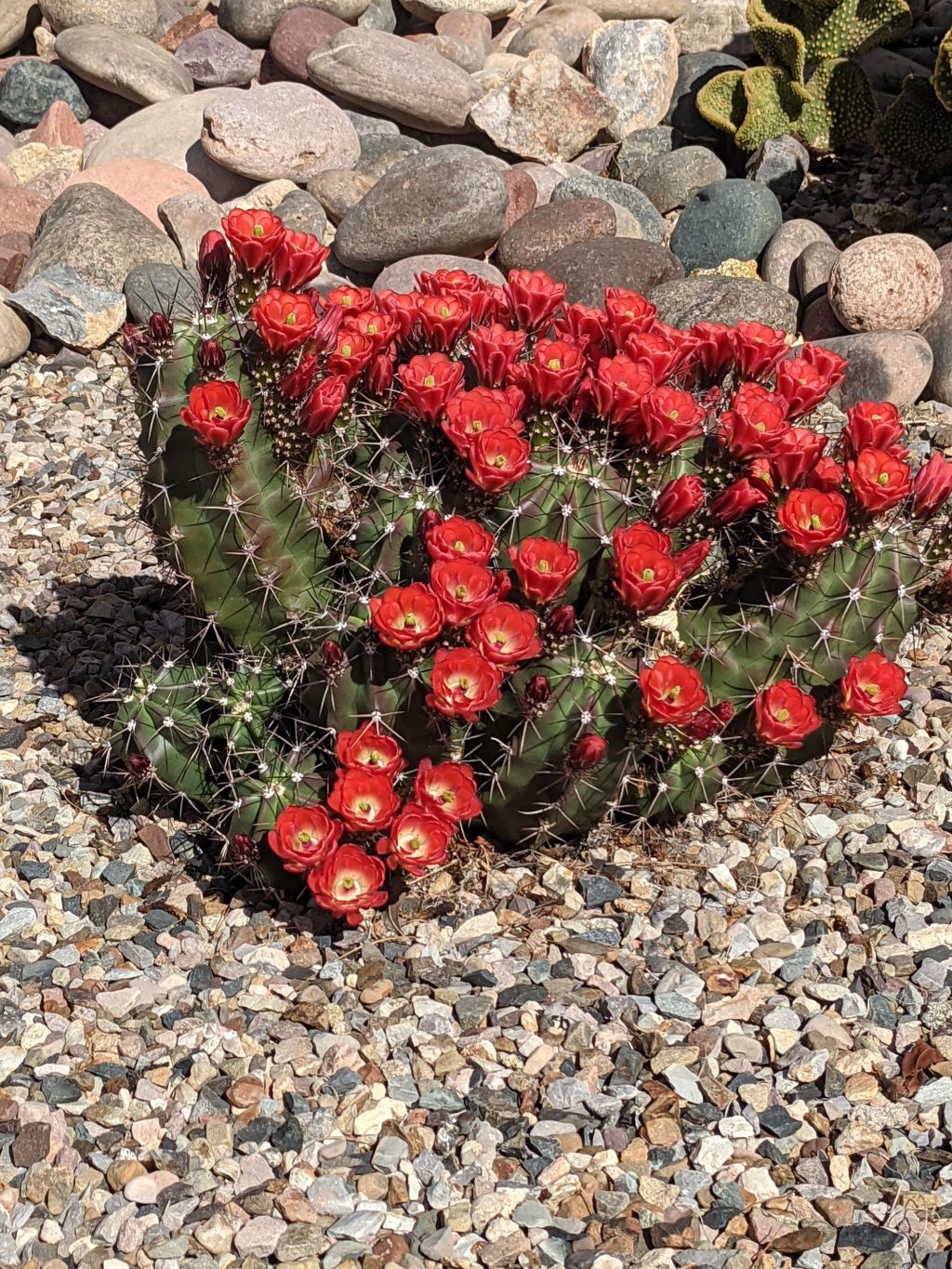
When the cactus blooms it can be really spectacular. Lots of beautiful color and often time many flowers from a relatively small plant.
This is a Ladder-backed Woodpecker going after what is left of an orange. The oranges attract a wide variety of bird species probably for the sugar content and resultant energy. If you look closely at the photo you will see the ants are attracted to the orange as well. The woodpecker might add a little protein to his meal with some of the ants. Some of the woodpeckers especially the Northern Flicker feed a lot on ants.
This wild flower blooms in the spring and much of the summer and is called a prickly poppy. Many of the flowers around here have many names but prickly seems appropriate for this plant. The leaf structure seems to resemble a thistle. We see these in a lot of place as we travel around, not in big massive fields like the California Poppies but in sufficient quantity to catch your attention.
This is a good example of a Lark Sparrow. For some reason there is an extreme abundance of this species this year. We see them everywhere. They are easy to identify due to the striking facial markings.
No this is not our “Bird Mobile”. We saw this in the Safeway parking lot. There are a number of owls on the roof and almost every square inch of the vehicle is covered with bird or other paraphernalia, even the wheels for the tires. I think the resale value has been dramatically reduced unless you find that certain someone who just has to have this car. Not sure if you have to wax the car to maintain it's pristine condition.
In an earlier blog post we showed a Summer Tanager female, she was a different color than this, here is the male of the species, bright red in color.
This is a Wilson ’s warbler. Warblers are pretty much migratory birds. They pass through here in the spring heading north. This bird was grabbing an insect on a branch higher up and was coming back down when I got this image. They are yellow with a pronounced black cap.
This is an American Coot. They are not the most graceful flyers and need to run across the water to get airborne. The image shows a little action. They are seen in and around the water all the time but their feet are not webbed, as a duck's feet are, they are lobed, hence when they swim it is with a really jerky motion.
Here is an adult Black-crowned Night Heron. They feed on fish and aquatic critters. They will sit by the edge pf the water and wait for an unsuspecting meal to swim by where they will hurriedly grab them with their large beak.
This is a juvenile or young Black-crowned Night Heron. He has not developed the coloration of the adult. He spent a lot of time just loafing and basking in the sun. The adult in the above image was not very far away we are sure keeping a watchful eye. Note how large the beak is on this juvenile, one serious beak.
This image of a hummingbird was interesting due to the lighting. I was trying to stop the wings in motion and had a fast shutter speed. The camera in its compensation made the background dark. I used some software to lighten up the image and achieve this effect.
We hope you enjoyed this look at some plants and birds and perhaps your future bird mobile, or at least an inventive mode of transportation with some creative ideas for your own car.
Please let us know if you have any questions or comments.
All the best – George & Deanna
This is a plant called a Sacred Datura. It is a perennial plant that we see around here in Southern Arizona in the late spring. It is a very nice looking flower but it is poisonous. Purportedly it is sometimes used as a hallucinogen due to its psychoactive alkaloids but we have not tried that facet of the plant as of yet and most likely won’t.
This is another plant or was a plant, mostly twigs now. It was an Anaheim Pepper plant in our small garden but the mice decided they needed a pepper leaf salad for dinner.
There are now a few less mice in the area. Everyone around here has mice problems in their gardens, it is really dry and it seems there is little food for them hence the garden is a great smorgasbord. Last year we had no mice problems what so ever.
This is a Northern-rough Winged Swallow in flight. The swallows are really hard to capture while in flight. They are very irregular in their movements and rather fast. I am only glad for the digital camera and not having to incur the time and expense of slides just trying to get an image of one of these swallows.
Here is a fascinating ant mound. Our good friend Rodger says they are Harvester Ants because of all the green vegetation around the ant hill. It was most curious as there is no green vegetation with 25 -30 feet of this circle. They certainly are busy.
This is an Ash-throated Flycatcher. According to the Audubon Web site and other Internet sources "they live in dry terrain where trees are often small or scarce, they will resort to other sites for nesting; nests have been found in such odd places as exhaust pipes, hollow fence posts, mailboxes, and even in trousers hanging on a clothesline." Certainly an enterprising bird.
When the cactus blooms it can be really spectacular. Lots of beautiful color and often time many flowers from a relatively small plant.
This is a Ladder-backed Woodpecker going after what is left of an orange. The oranges attract a wide variety of bird species probably for the sugar content and resultant energy. If you look closely at the photo you will see the ants are attracted to the orange as well. The woodpecker might add a little protein to his meal with some of the ants. Some of the woodpeckers especially the Northern Flicker feed a lot on ants.
This wild flower blooms in the spring and much of the summer and is called a prickly poppy. Many of the flowers around here have many names but prickly seems appropriate for this plant. The leaf structure seems to resemble a thistle. We see these in a lot of place as we travel around, not in big massive fields like the California Poppies but in sufficient quantity to catch your attention.
This is a good example of a Lark Sparrow. For some reason there is an extreme abundance of this species this year. We see them everywhere. They are easy to identify due to the striking facial markings.
No this is not our “Bird Mobile”. We saw this in the Safeway parking lot. There are a number of owls on the roof and almost every square inch of the vehicle is covered with bird or other paraphernalia, even the wheels for the tires. I think the resale value has been dramatically reduced unless you find that certain someone who just has to have this car. Not sure if you have to wax the car to maintain it's pristine condition.
In an earlier blog post we showed a Summer Tanager female, she was a different color than this, here is the male of the species, bright red in color.
This is a Wilson ’s warbler. Warblers are pretty much migratory birds. They pass through here in the spring heading north. This bird was grabbing an insect on a branch higher up and was coming back down when I got this image. They are yellow with a pronounced black cap.
This is an American Coot. They are not the most graceful flyers and need to run across the water to get airborne. The image shows a little action. They are seen in and around the water all the time but their feet are not webbed, as a duck's feet are, they are lobed, hence when they swim it is with a really jerky motion.
Here is an adult Black-crowned Night Heron. They feed on fish and aquatic critters. They will sit by the edge pf the water and wait for an unsuspecting meal to swim by where they will hurriedly grab them with their large beak.
This is a juvenile or young Black-crowned Night Heron. He has not developed the coloration of the adult. He spent a lot of time just loafing and basking in the sun. The adult in the above image was not very far away we are sure keeping a watchful eye. Note how large the beak is on this juvenile, one serious beak.
This image of a hummingbird was interesting due to the lighting. I was trying to stop the wings in motion and had a fast shutter speed. The camera in its compensation made the background dark. I used some software to lighten up the image and achieve this effect.
We hope you enjoyed this look at some plants and birds and perhaps your future bird mobile, or at least an inventive mode of transportation with some creative ideas for your own car.
Please let us know if you have any questions or comments.
All the best – George & Deanna
Subscribe to:
Posts (Atom)